


Stop Leaking Leads: The Healthcare Website Conversion Checklist
Is your website a digital brochure or a lead-generation engine?
For most healthcare providers, it is, unfortunately, the former. You may have invested significantly in a clean design, high-quality photos of your office, and a carefully written “About Us” page. Yet, when you check your analytics, traffic is present but phones aren’t ringing and appointments aren’t being booked.
In the world of Health Providers Digital Marketing Solutions, we frequently encounter “leaky bucket” syndrome. High-intent traffic—people actively searching for a doctor, therapist, or specialist—is expensive to acquire. Whether you are paying for clicks or earning them through organic search, every visitor who leaves without taking action represents a wasted investment.
To scale, you must adopt a conversion-first mindset. This means prioritizing the patient’s next step over “aesthetic fluff.” If your website doesn’t make it effortless for a patient to choose you, they will choose a competitor. Here is the definitive checklist to stop the leaks and start converting.
1. Trust Signals and Clinical Authority
 In healthcare, the “Trust Bar” is significantly higher than in almost any other industry. Google categorizes healthcare websites as “Your Money or Your Life” (YMYL), meaning they hold your content to rigorous standards of E-E-A-T: Experience, Expertise, Authoritativeness, and Trustworthiness.
Patients aren’t just looking for a service; they are looking for a credible authority they can trust with their well-being.
- Professional Bio Pages: Does every provider have a detailed bio? Don’t just list a degree. Include board certifications, specific clinical interests, and a philosophy of care.
- Authentic Photography vs. Stock Images: Stock photos of people with perfect teeth laughing at a salad feel clinical and impersonal. Use high-resolution, professional photos of your actual providers and facility to humanize your practice.
- Professional Branding: A dated logo or non-responsive design signals a lack of attention to detail—not the message you want to send in medicine. Consistent Branding communicates stability and excellence.
- Social Proof: Display HIPAA-compliant testimonials or patient satisfaction scores. Seeing positive outcomes from others reduces the perceived risk for new patients.
2. The Direct, Frictionless Path (UX & Navigation)
User Experience (UX) in healthcare isn’t about being “fancy”; it’s about being helpful. A patient visiting your site might be in pain, stressed, or in a hurry. If they can’t find what they need in seconds, they’re gone.
- The Three-Click Rule: A user should be able to find a specific service or reach a booking page in three clicks or fewer. If your navigation is a maze, your conversion rate will suffer.
- Mobile-First Reality: Most patients search for healthcare on their phones while on the go. If your mobile site is merely a “shrunken” version of your desktop site with tiny, unclickable buttons, you are actively losing leads.
- Speed is a Feature: A 3-second delay in load time can result in a 50% bounce rate. Modern Website Design must prioritize performance and Core Web Vitals to keep users engaged and Google satisfied.
3. High-Intent Messaging & Offers
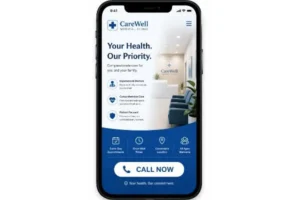 Medical jargon is a conversion killer. Patients typically don’t search for “Comprehensive Integrated Orthopedic Modalities”; they search for “Back pain relief.”
Benefit-Driven Headlines: Shift your messaging from what you do to what the patient gains*. Use headlines that address their pain points and offer immediate solutions.
- The Primary Call to Action (CTA): Every page should have one clear, dominant CTA. Whether it’s “Call Now,” “Book Online,” or “Request a Consultation,” make it stand out with a high-contrast color.
- Secondary CTAs: Not everyone is ready to book immediately. For those in the research phase, offer “Education” CTAs—such as a downloadable guide on a specific condition—to capture their email address for future nurturing.
- Lowering the Barrier: Use high-value offers like a “15-Minute Discovery Call” or a “New Patient Special” to encourage that first engagement.
4. Simplified Lead Capture & CRM Integration
If your contact form resembles a mortgage application, your completion rates will crater. Every additional field you add decreases the likelihood of a conversion.
- Audit Your Forms: Ask only for the essentials: Name, Phone, Email, and a brief note. Ensure all forms are HIPAA-compliant to protect patient privacy.
- Click-to-Call Buttons: On mobile, your phone number shouldn’t just be text. It should be a prominent, clickable button fixed to the header or footer.
- Eliminate the “Black Hole”: What happens after someone clicks “Submit”? If a lead sits in an email inbox for three days, it’s dead. Your website should be connected to a CRM for immediate follow-up via automated text or email confirmations.
5. Local SEO & Location Consistency
For multi-location practices, your website must serve as a localized gateway for each community you serve.
- Location-Specific Pages: Don’t just list five addresses on one page. Build dedicated landing pages for each location that include local phone numbers, maps, and specific provider lists. This is the cornerstone of Local Business Digital Marketing.
- Message Matching: If a patient clicks an ad for “Fertility Clinic in Los Angeles,” they should land on a page that prominently features “Los Angeles.” If they have to search for the location again, they’ll bounce.
- Google Business Profile: Ensure your website links directly to your Google reviews and that your NAP (Name, Address, Phone) data is identical across the web.
6. The Follow-Up: Closing the Conversion Loop
A “conversion” on your website is just the beginning. The goal isn’t a form submission; it’s a patient in your chair.
- Automated Confirmations: Immediate gratification is key. An automated “Thank you, we received your request” message sets expectations and builds immediate trust.
- End Vague Timelines: “We will get back to you soon” is a recipe for a patient calling your competitor. Use specific language: “A patient coordinator will call you within two hours.”
- Track What Actually Generates Revenue: Focus beyond “hits” or “sessions.” Start tracking “Cost Per Qualified Lead” and “Booked Appointments.” True Search engine optimization (SEO) success is measured by revenue, not just rankings.
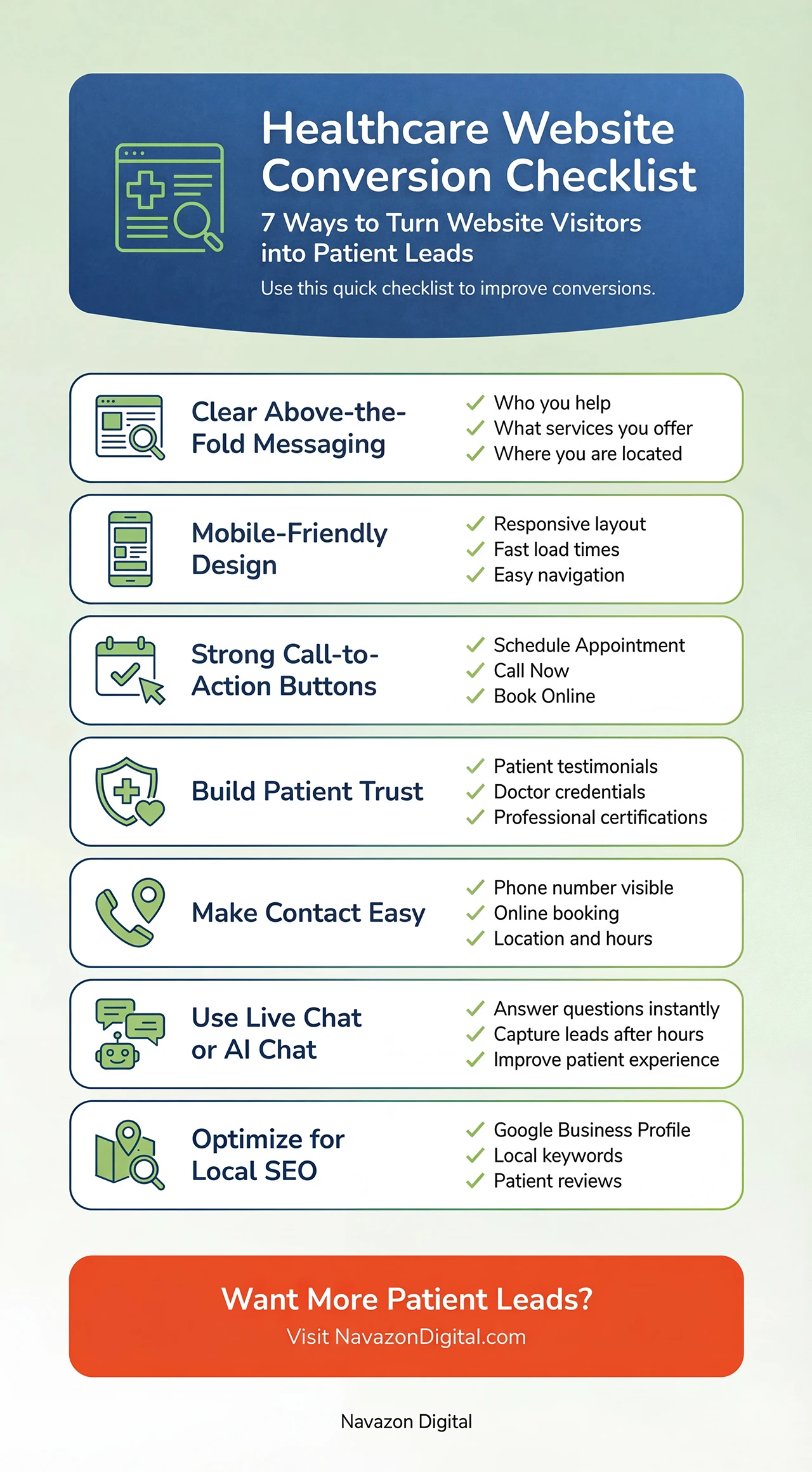
Your Next Steps: Stop the Leak
Healthcare is a high-stakes, competitive field. To win, you don’t need the flashiest website—you need the one that best serves the patient’s intent and turns that intent into action.
 At Navazon Digital, we specialize in high-performance digital marketing for the medical field, from Behavioral Health Marketing to specialized surgical clinics. We don’t just build websites; we build growth engines.
Is your website working for you?
Don’t leave your lead flow to chance. Schedule a 30-Minute Conversion Review with our team. We’ll analyze your homepage and your primary service pages to identify exactly where patients are dropping off and provide a prioritized fix list to help you scale.
Schedule Your 30-Minute Conversion Review Today[/vc_column_text][/vc_column][/vc_row]







Leave a Reply
You must be logged in to post a comment.